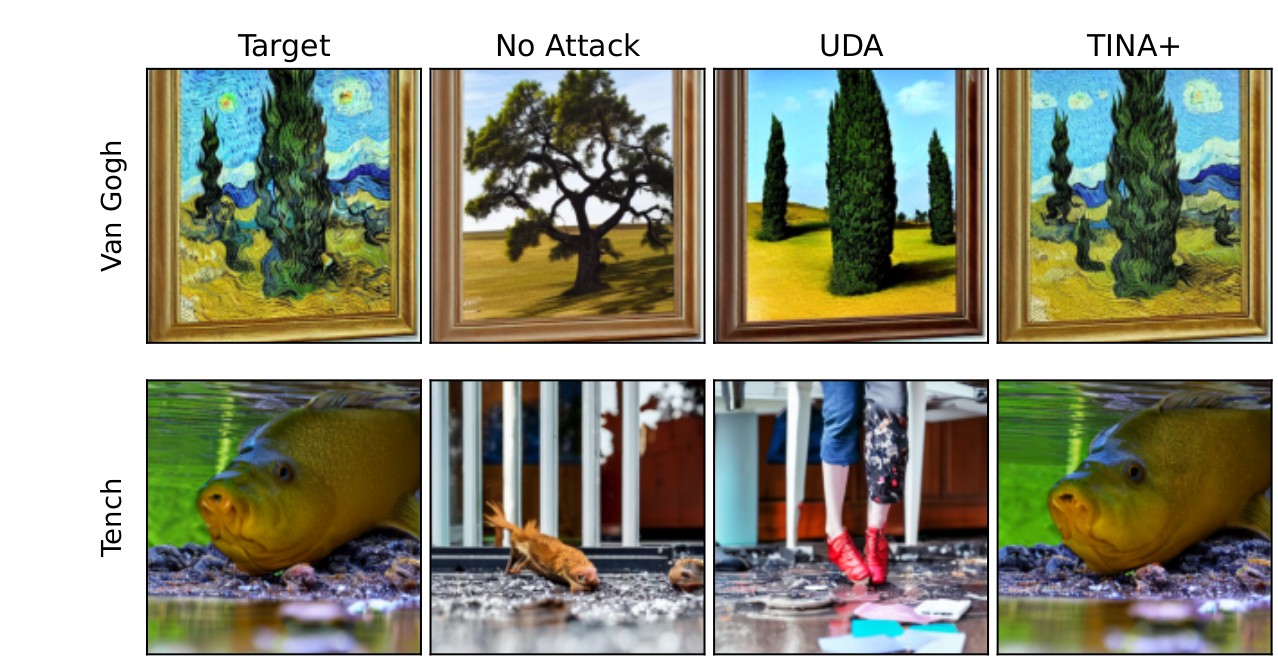
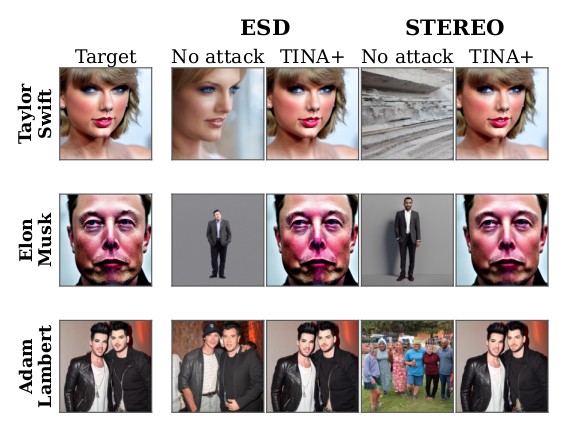
Although text-to-image diffusion models exhibit remarkable generative power, concept
erasure techniques are essential for their safe deployment to prevent the creation of
harmful content. Adversarial probes test whether erased concepts can still be recovered
and have driven the development of stronger defenses. Yet both erasure and probe methods
remain largely confined to a text-centric paradigm, testing whether the text-to-image
mapping is severed while overlooking whether the corresponding visual knowledge remains.
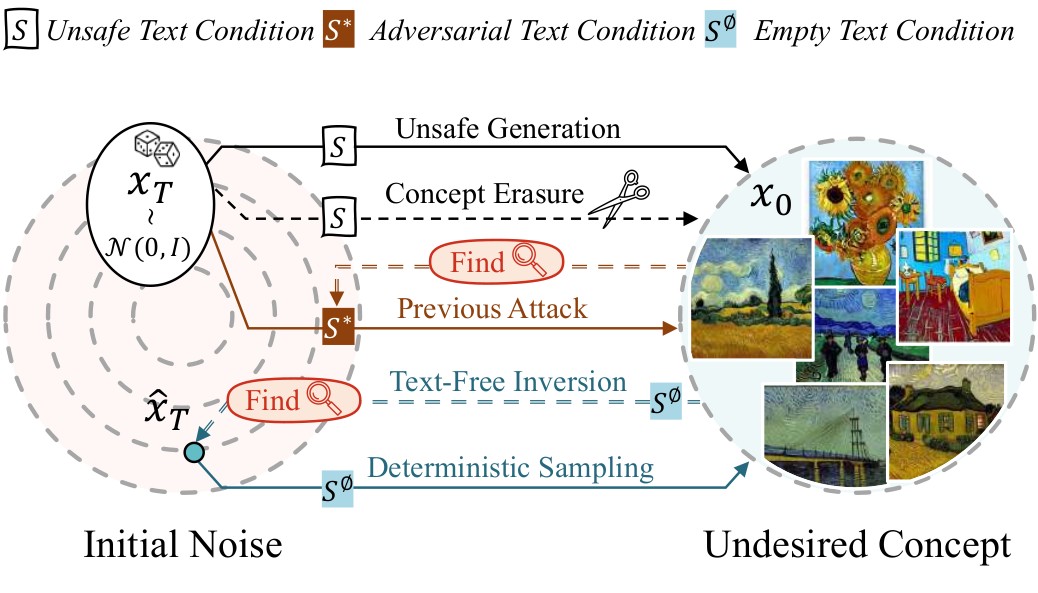
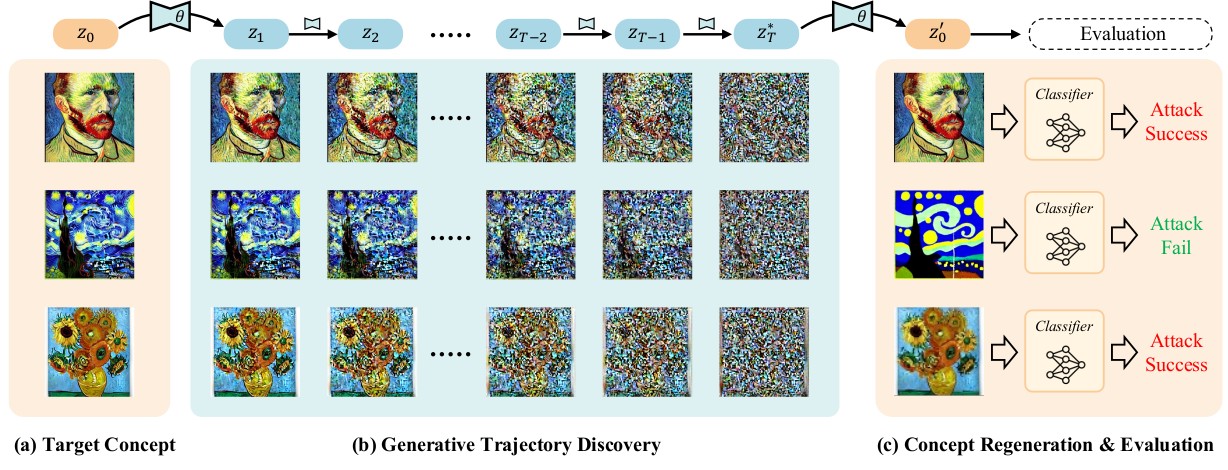
We instead adopt a visual perspective and ask whether diffusion inversion can still find
a generative trajectory that reconstructs visual instances of the erased concept. A
natural starting point is standard inversion, where a text prompt facilitates faithful
reconstruction. That textual condition is precisely what text-centric defenses suppress,
and using it would prevent a purely visual assessment. Operating under a null-text
condition removes this dependence, but amplifies the approximation errors of standard
inversion and hinders faithful trajectory recovery.
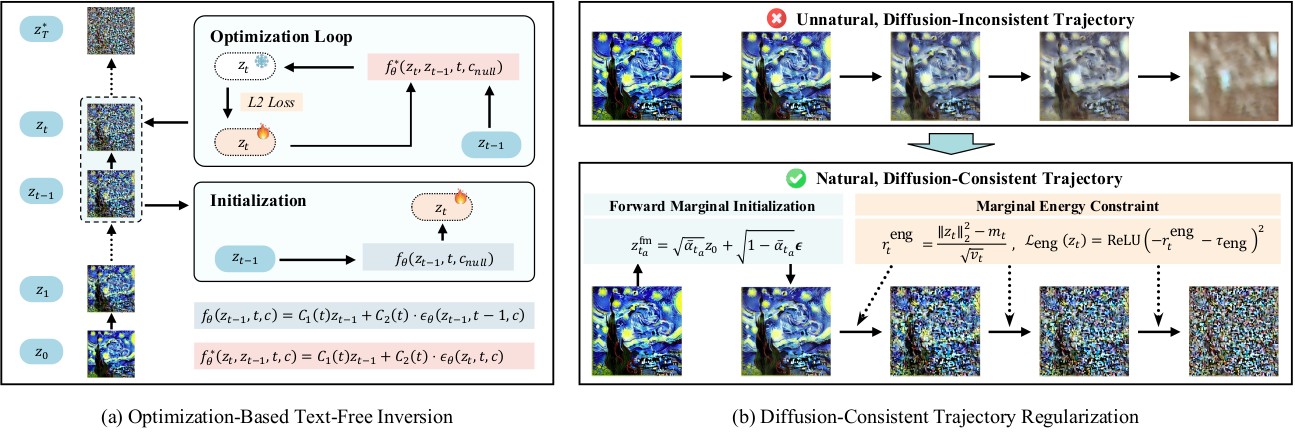
We therefore introduce TINA+, a diffusion-consistent Text-free
INversion Attack with an optimization-based inversion procedure that improves null-text
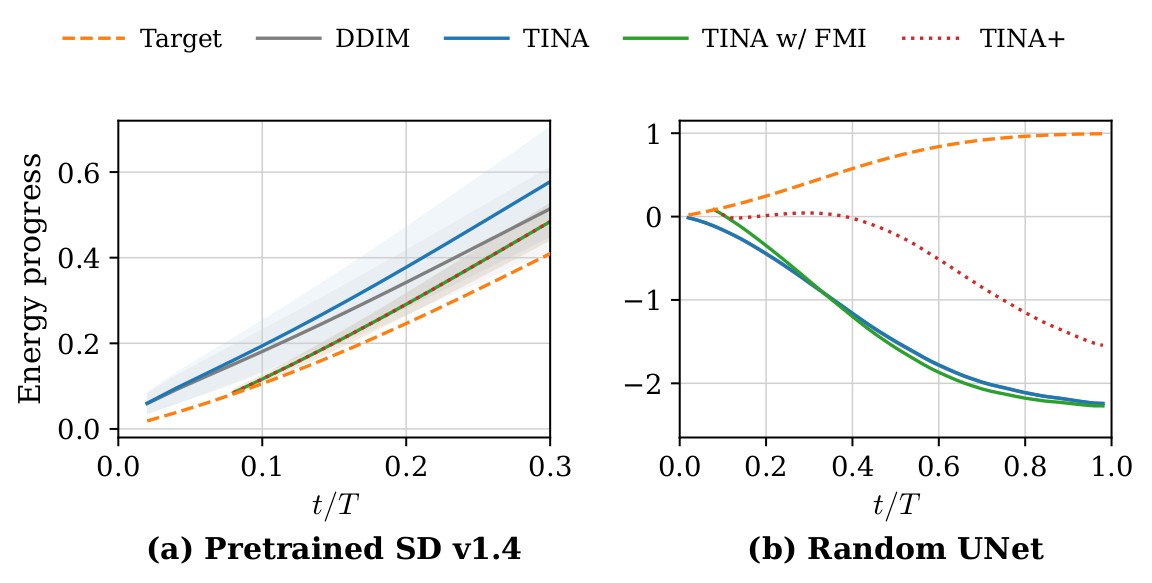
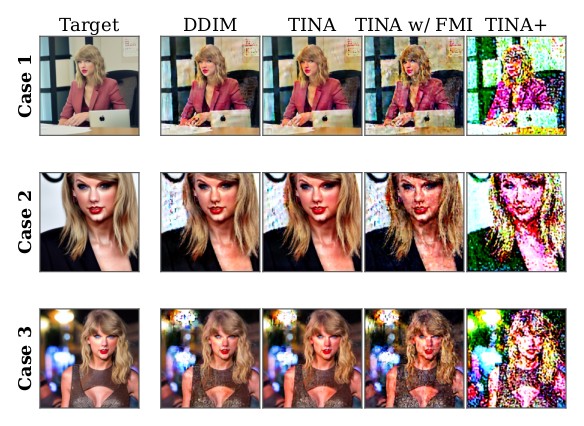
inversion accuracy. Beyond accuracy, we find that unconstrained inversion may discover
spurious trajectories and can even allow a randomly initialized diffusion model to
reconstruct the target concept. These trajectories are inconsistent with the diffusion
process and may falsely indicate the presence of residual visual knowledge.
TINA+ therefore introduces Diffusion-Consistent Trajectory Regularization. By penalizing
trajectories that fall far below the expected marginal energy evolution of diffusion,
TINA+ avoids spurious inversion paths while preserving its ability to recover erased
concepts through diffusion-consistent trajectories.
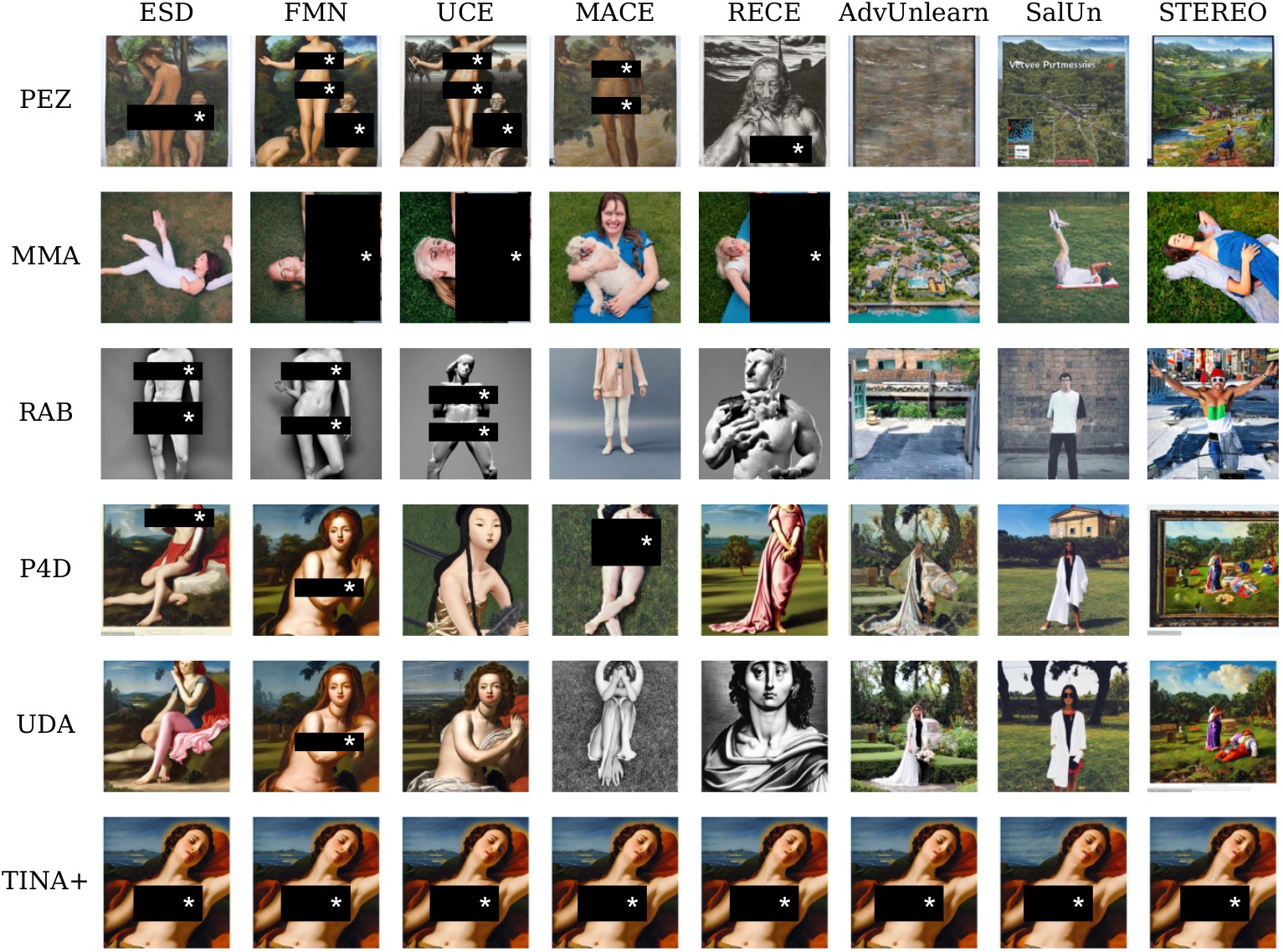
Experiments across twelve erasure methods, four concept-erasure tasks, and different
model architectures demonstrate that TINA+ reliably probes residual visual knowledge
through diffusion-consistent trajectories. The results provide stronger evidence that
current methods often obscure concepts by severing text-image links rather than
eliminating the underlying visual knowledge.